Transferring 60 Community College Credits: Cut Bachelor Degree Timelines to 18 Months

Advertisements
Statewide articulation agreements are fundamentally reshaping higher education by streamlining the process of transferring 60 community college credits. This critical development allows students to significantly reduce the time needed to complete a bachelor’s degree, often cutting timelines to just 18 months. Understanding these agreements is key for prospective students aiming for efficient academic progression.
Transferring 60 Community College Credits: How Statewide Articulation Agreements Cut Bachelor Degree Timelines to 18 Months is shaping today’s educational landscape, offering an accelerated pathway for countless students. This transformative approach is gaining significant traction across the United States, providing a clear and efficient route from associate’s to bachelor’s degrees.
The impact of these agreements extends beyond mere academic convenience; they represent a significant stride towards making higher education more accessible and affordable. As more states adopt and refine these frameworks, the opportunities for students to save time and tuition costs continue to expand, directly addressing common barriers to degree completion.
Understanding Statewide Articulation Agreements
Statewide articulation agreements are formal partnerships between community colleges and four-year universities designed to ensure that credits earned at one institution are seamlessly accepted at another. These agreements standardize the transfer process, eliminating uncertainty and maximizing the value of community college coursework.
The primary goal is to create clear pathways for students to progress from an associate’s degree to a bachelor’s degree without losing valuable credits or incurring unnecessary expenses. This structured approach helps students plan their academic journey more effectively from the outset, knowing exactly which courses will count towards their desired four-year degree.
These agreements typically outline specific course equivalencies and program requirements, ensuring that students who complete a designated associate’s degree can transfer directly into a corresponding bachelor’s program with junior standing. This significantly streamlines the process of transferring 60 community college credits.
The Mechanism of Credit Transfer
The core of these agreements lies in their detailed course mappings. Each agreement specifies which community college courses will fulfill general education requirements and major prerequisites at the receiving university, ensuring that the transferring 60 community college credits process is smooth.
- Course-by-course equivalencies are often explicitly listed, providing clarity for both students and academic advisors.
- Block transfer options allow for an entire associate’s degree to fulfill a significant portion of a bachelor’s degree, typically the first two years.
- Program-specific agreements ensure that credits earned in a particular associate’s degree program align directly with a corresponding bachelor’s program.
Without these agreements, students often face the daunting task of individually petitioning for credit acceptance, a process that can be time-consuming and frequently results in lost credits. The structured nature of articulation agreements mitigates this risk, making the process of transferring 60 community college credits much more predictable.
The 18-Month Bachelor Degree Timeline
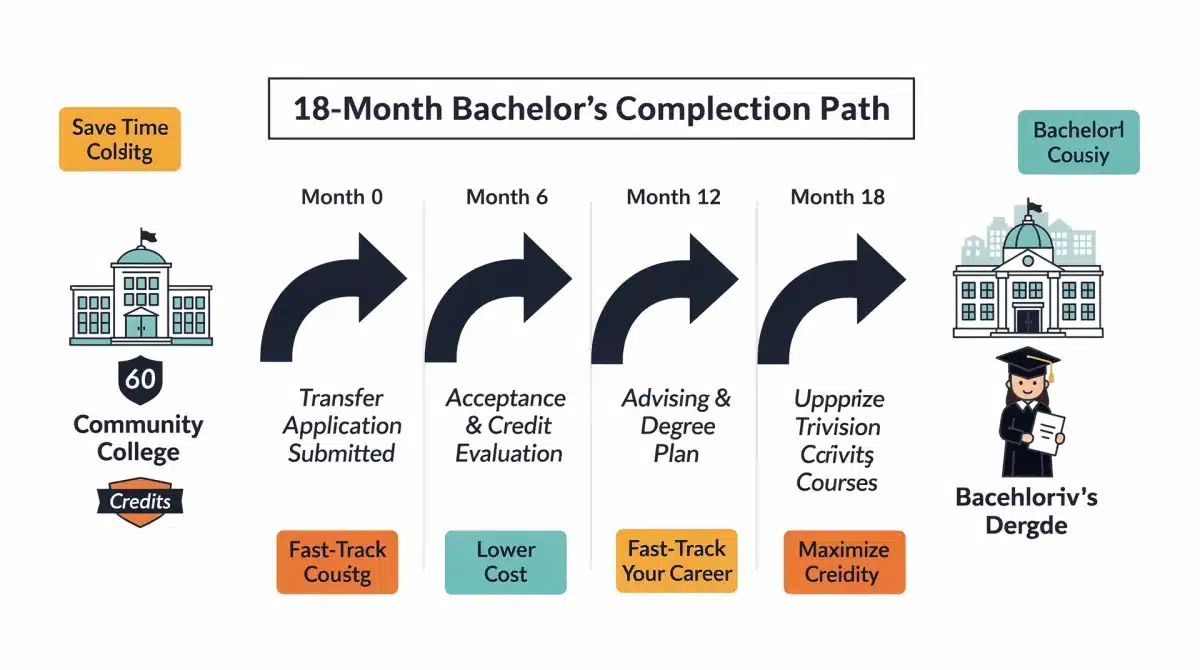
The promise of completing a bachelor’s degree in 18 months after obtaining an associate’s degree is a powerful incentive for many students. This accelerated timeline is a direct outcome of effective statewide articulation agreements, which optimize the credit transfer process.
By ensuring that all 60 community college credits transfer efficiently, students can enter a four-year institution with the equivalent of two years of college coursework already completed. This allows them to focus immediately on upper-division courses required for their major, significantly reducing their overall time to graduation.
This accelerated path not only saves time but also substantially reduces the financial burden of a bachelor’s degree. Fewer semesters at a typically more expensive four-year institution translate into considerable savings on tuition, fees, and living expenses, making higher education more attainable.
Strategic Planning for Accelerated Completion
Achieving the 18-month bachelor’s degree timeline requires meticulous planning and adherence to the specific requirements of articulation agreements. Students must work closely with advisors at both their community college and prospective university to ensure they are on the correct path for transferring 60 community college credits.
Early engagement with academic advising is paramount. Students should identify their target four-year institution and desired major as early as possible in their community college career. This allows them to select courses that align perfectly with the articulation agreement, maximizing transferable credits.
Maintaining a strong academic record at the community college is also crucial. Many articulation agreements require a minimum GPA for admission into the partner university, ensuring that students are well-prepared for the rigor of upper-division coursework.
Benefits for Students and Educational Institutions
The advantages of robust articulation agreements extend beyond just accelerated degree completion for students. These frameworks foster a more cohesive and efficient higher education system, benefiting both individual learners and the institutions themselves.
For students, the clarity and predictability offered by these agreements reduce stress and provide a clear roadmap to their academic goals. This increased transparency encourages more students to pursue higher education, knowing that their efforts at community college will be fully recognized.
Educational institutions also gain from these partnerships. Universities benefit from a steady pipeline of well-prepared transfer students, often with strong foundational skills. Community colleges, in turn, see increased enrollment and better student outcomes, as their graduates have clear pathways to further education.
Enhancing Accessibility and Affordability
One of the most significant impacts of effective articulation agreements is their role in enhancing the accessibility and affordability of higher education. Community colleges offer a more budget-friendly entry point into higher education, and seamless transfer mechanisms amplify this advantage.
Students can complete their general education requirements and foundational courses at a fraction of the cost of a four-year university. By ensuring that these credits transfer, the overall cost of a bachelor’s degree is substantially reduced, making it a viable option for a broader demographic.
This financial relief, coupled with the reduced time to degree, opens doors for students who might otherwise be deterred by the high costs and lengthy commitments associated with traditional four-year programs. It democratizes access to higher education by providing a more economically feasible route.
Challenges and Considerations in Transferring Credits
While statewide articulation agreements offer significant advantages, students may still encounter challenges. Understanding these potential hurdles is crucial for navigating the transfer process successfully and ensuring the efficient transferring 60 community college credits.
Variations in agreement details between states and even between institutions within the same state can create complexities. Students must meticulously review the specific terms of the agreement relevant to their chosen path to avoid any surprises.
Course numbering systems and curriculum differences can sometimes lead to minor discrepancies, even with an agreement in place. Proactive communication with academic advisors at both institutions is key to resolving these issues before they become major obstacles.
Navigating Specific Program Requirements
Some specialized programs or highly competitive majors may have additional requirements beyond the general articulation agreement. Students pursuing these fields need to be particularly diligent in their planning for transferring 60 community college credits.
Specific prerequisite courses, higher GPA requirements, or portfolio submissions might be necessary for admission to certain university departments. These program-specific nuances often require careful attention to detail during course selection at the community college level.
Students should consult departmental advisors at their target university early on to understand any unique demands of their intended major. This foresight can prevent delays and ensure a smooth transition into their chosen bachelor’s program after transferring 60 community college credits.
The Role of Academic Advising
Effective academic advising is the cornerstone of successful credit transfer, particularly when aiming for an accelerated degree timeline. Advisors serve as invaluable guides, helping students navigate the intricacies of articulation agreements and optimize their course selections for transferring 60 community college credits.
Community college advisors can help students identify the most appropriate articulation agreement for their desired major and university. They provide guidance on course sequencing and ensure that students complete all necessary prerequisites before transferring, setting them up for success.
Upon transferring, university advisors assist students in integrating their community college credits into their bachelor’s degree plan. They help with course registration, major declaration, and ensure students remain on track to complete their degree within the desired 18-month timeframe.
Building a Seamless Academic Plan
A collaborative approach between the student and advisors at both institutions is critical for building a seamless academic plan. This continuous dialogue helps to anticipate and address any potential issues related to transferring 60 community college credits.
- Regular check-ins with advisors ensure that students are meeting all requirements for both their associate’s degree and their intended bachelor’s program.
- Advisors can help interpret complex articulation agreement language and clarify any ambiguities regarding course equivalencies.
- They can also provide insights into specific university policies or departmental requirements that might impact the transfer process.
By leveraging the expertise of academic advisors, students can confidently pursue their educational goals, knowing they have a clear and supported path to a bachelor’s degree after successfully transferring 60 community college credits.
Success Stories and Future Outlook
Numerous students have already benefited from the efficiency of statewide articulation agreements, successfully completing their bachelor’s degrees in significantly reduced timelines. These success stories underscore the power of these frameworks in transforming educational journeys and highlight the potential for even greater impact in the future.
From students saving tens of thousands of dollars in tuition to professionals re-entering academia for career advancement, the positive outcomes are diverse and compelling. These examples serve as powerful testimonials to the effectiveness of organized credit transfer systems, particularly for transferring 60 community college credits.
Looking ahead, the trend towards enhanced articulation agreements is expected to continue. As states recognize the economic and social benefits of more efficient higher education pathways, further investments in standardizing and expanding these agreements are anticipated, making the process of transferring 60 community college credits even more accessible.
Expanding Reach and Refining Processes
The future of articulation agreements involves not only expanding their reach to more institutions and programs but also refining their processes for even greater transparency and ease of use. This continuous improvement will further solidify the pathway for transferring 60 community college credits.

Efforts are underway in many states to create universal transfer pathways, where an associate’s degree in a specific field guarantees admission and junior standing in a related bachelor’s program across all public universities. Such initiatives simplify the decision-making process for students and enhance predictability.
Technological advancements, such as online transfer planning tools and integrated student information systems, are also playing a crucial role in streamlining the process. These tools empower students with real-time information about credit equivalencies and degree progression, making the process of transferring 60 community college credits more transparent.
Policy and Legislative Impact
State governments and educational legislatures play a pivotal role in establishing and strengthening statewide articulation agreements. Their policy decisions directly influence the effectiveness and breadth of these transfer pathways, directly impacting students’ ability to benefit from transferring 60 community college credits.
Legislation often mandates the creation of these agreements, sets standards for credit acceptance, and allocates funding to support their implementation. These policy frameworks ensure that higher education institutions collaborate effectively to serve student needs.
Ongoing legislative efforts aim to further standardize transfer policies, reduce barriers, and promote equity in higher education. This includes measures to ensure that credits earned from diverse community college programs are uniformly recognized across state university systems, facilitating the process of transferring 60 community college credits.
Advocacy for Streamlined Transfer
Advocacy groups and educational organizations are continuously working to champion policies that support seamless credit transfer. Their efforts help to keep the focus on student success and the importance of efficient pathways for transferring 60 community college credits.
- These groups often lobby for increased funding for transfer initiatives and for policies that protect students from losing credits during the transfer process.
- They also work to raise awareness among students and educators about the benefits and mechanisms of articulation agreements.
- Their advocacy ensures that the needs of transfer students remain a priority in state-level educational planning and resource allocation.
By fostering a supportive legislative and policy environment, states can ensure that the promise of accelerated degree completion through articulation agreements becomes a reality for more students across the nation, making the process of transferring 60 community college credits a cornerstone of accessible education.
| Key Point | Brief Description |
|---|---|
| Accelerated Degrees | Transferring 60 community college credits can cut bachelor’s degree time to 18 months. |
| Articulation Agreements | Formal pacts ensure seamless credit acceptance between colleges and universities. |
| Cost Savings | Completing first two years at community college significantly reduces total tuition costs. |
| Academic Advising | Essential for navigating transfer pathways and maximizing credit acceptance. |
Frequently Asked Questions About Credit Transfer
Statewide articulation agreements are formal, legally binding pacts between community colleges and four-year universities within a state. They standardize the acceptance of community college credits towards bachelor’s degrees, ensuring that students can transfer seamlessly without losing academic progress or incurring unnecessary costs, especially when transferring 60 community college credits.
By transferring 60 community college credits, students effectively complete the first two years of a bachelor’s degree at a community college. This allows them to enter a four-year university with junior standing, focusing immediately on upper-division courses. With careful planning and full-time enrollment, the remaining coursework can often be completed in three to four semesters, totaling about 18 months.
While statewide articulation agreements significantly increase transferability, not all credits are guaranteed. Credits must align with the specific terms of the agreement and the requirements of the chosen bachelor’s program. Students must select courses carefully at their community college, ideally with advisor guidance, to ensure maximum transferability, especially when aiming to transfer 60 community college credits.
Academic advisors are crucial. They help students identify the right articulation agreements, select appropriate courses at the community college, and plan their academic path to meet university requirements. Consulting with advisors at both institutions ensures a smooth transition and maximizes the number of accepted credits, making the process of transferring 60 community college credits efficient.
The financial benefits are substantial. Community college tuition is typically much lower than university tuition. By completing the first two years at a community college and then transferring 60 community college credits, students can save thousands of dollars on tuition, fees, and living expenses, making a bachelor’s degree more affordable and accessible.
Impact and Implications
The increasing prevalence and refinement of statewide articulation agreements signify a profound shift in higher education, prioritizing student efficiency and access. This framework for transferring 60 community college credits is not merely a policy; it is a practical solution addressing the rising costs and extended timelines often associated with bachelor’s degrees. As more states embrace and enhance these initiatives, the landscape of higher education will continue to evolve, offering clearer, more affordable, and faster pathways to advanced degrees for a broader range of students. The focus remains on optimizing the student journey from community college to university completion, with the impact resonating across individual lives and the broader economy.