Federal Employee Retirement Benefits: 2026 COLA Explained
Latest developments on Federal Employee Retirement Benefits (FERS/CSRS): 2026 Cost-of-Living Adjustments Explained, with key facts, verified sources, and what readers need to monitor next in the United States, presented clearly.
The topic of Federal Employee Retirement Benefits (FERS/CSRS): 2026 Cost-of-Living Adjustments Explained is shaping today’s agenda with new details released by officials and industry sources. This update prioritizes what changed, why it matters, and what to watch next, in a straightforward news format.
Understanding the intricacies of these adjustments is crucial for current and future federal retirees planning their financial well-being. The forthcoming 2026 COLA will directly impact the purchasing power of their annuities.
Anticipating the 2026 COLA for Federal Retirees
Federal retirees under both the Federal Employees Retirement System (FERS) and the Civil Service Retirement System (CSRS) eagerly await announcements regarding their annual Cost-of-Living Adjustments (COLA). These adjustments are critical for maintaining their purchasing power in the face of inflation, ensuring that their hard-earned benefits keep pace with rising costs.
While the official 2026 COLA will not be determined until the fall of 2025, based on the Consumer Price Index for Urban Wage Earners and Clerical Workers (CPI-W) data, preliminary forecasts and economic trends offer valuable insights. Monitoring these early indicators is essential for proactive financial planning among federal employees and retirees.
The methodology for calculating COLA differs slightly between FERS and CSRS retirees, a distinction that significantly influences the final adjustment percentages. Understanding these nuances is key to comprehending the full scope of the 2026 COLA for federal employee retirement benefits.
Understanding the COLA Calculation Methodology
The annual COLA for federal annuity benefits is primarily tied to the CPI-W, which is a measure of inflation experienced by urban wage earners and clerical workers. The calculation typically compares the average CPI-W from the third quarter of one year to the third quarter of the subsequent year.
For the 2026 COLA, the key period for data collection will be the third quarter of 2025 (July, August, September) compared to the third quarter of 2024. The percentage increase in this index directly translates into the COLA percentage, though with specific caps for FERS beneficiaries.
This standardized approach ensures that adjustments are objective and reflect changes in the cost of living as measured by a widely accepted economic indicator. However, economic volatility can introduce significant fluctuations in these year-over-year comparisons.
Key Data Points for 2026 COLA
- CPI-W Data: The average CPI-W for July, August, and September 2025 will be the most critical data point for the 2026 COLA.
- Base Period: This will be compared against the average CPI-W for the third quarter of 2024 to determine the percentage increase.
- Official Announcement: The final COLA percentage is typically announced in October of the preceding year (October 2025 for the 2026 COLA).
The Bureau of Labor Statistics (BLS) releases the CPI-W data monthly, allowing analysts and retirees to track the progression of potential COLA increases throughout the year. Early indications often emerge as monthly reports are published, providing preliminary estimates for the Federal Employee Retirement Benefits (FERS/CSRS): 2026 Cost-of-Living Adjustments Explained.
Distinctions Between FERS and CSRS COLA
While both FERS and CSRS retirees receive COLA, there are crucial differences in how these adjustments are applied. CSRS retirees generally receive the full percentage increase determined by the CPI-W, without any caps or reductions.
FERS retirees, however, are subject to a tiered system. If the CPI-W increase is 2% or less, FERS retirees receive the full amount. If the CPI-W increase is between 2% and 3%, FERS retirees receive a flat 2%. If the CPI-W increase is greater than 3%, FERS retirees receive the CPI-W increase minus one percentage point.
These distinctions are vital for FERS beneficiaries to understand, as their COLA might not always fully match the official inflation rate. This difference can lead to a gradual erosion of purchasing power over time compared to their CSRS counterparts, highlighting a key aspect of Federal Employee Retirement Benefits (FERS/CSRS): 2026 Cost-of-Living Adjustments Explained.
Impact of FERS COLA Caps
- Lower Inflation: FERS and CSRS receive the same COLA if inflation is 2% or less.
- Moderate Inflation: FERS COLA is capped at 2% if inflation is between 2% and 3%.
- High Inflation: FERS COLA is 1% less than CSRS COLA if inflation exceeds 3%.
This tiered structure for FERS was designed as part of the system’s overall benefit package, which includes Social Security and the Thrift Savings Plan (TSP). It’s a significant factor for FERS retirees when evaluating the adequacy of their Federal Employee Retirement Benefits (FERS/CSRS): 2026 Cost-of-Living Adjustments Explained.
Economic Factors Influencing 2026 COLA Projections
Numerous economic factors play a pivotal role in shaping the CPI-W and, consequently, the 2026 COLA. Inflationary pressures, energy prices, supply chain dynamics, and global economic conditions all contribute to the overall cost of living. Analysts closely track these indicators to provide early projections.
Current economic forecasts suggest continued vigilance regarding inflation, although predictions vary widely. Factors such as geopolitical events, domestic fiscal policies, and labor market trends could significantly impact the trajectory of the CPI-W in the coming months, directly affecting Federal Employee Retirement Benefits (FERS/CSRS): 2026 Cost-of-Living Adjustments Explained.
For federal retirees, staying informed about these broader economic trends is just as important as understanding the specific COLA calculation methodology. These macroeconomic forces ultimately dictate the financial landscape in which their retirement benefits operate.
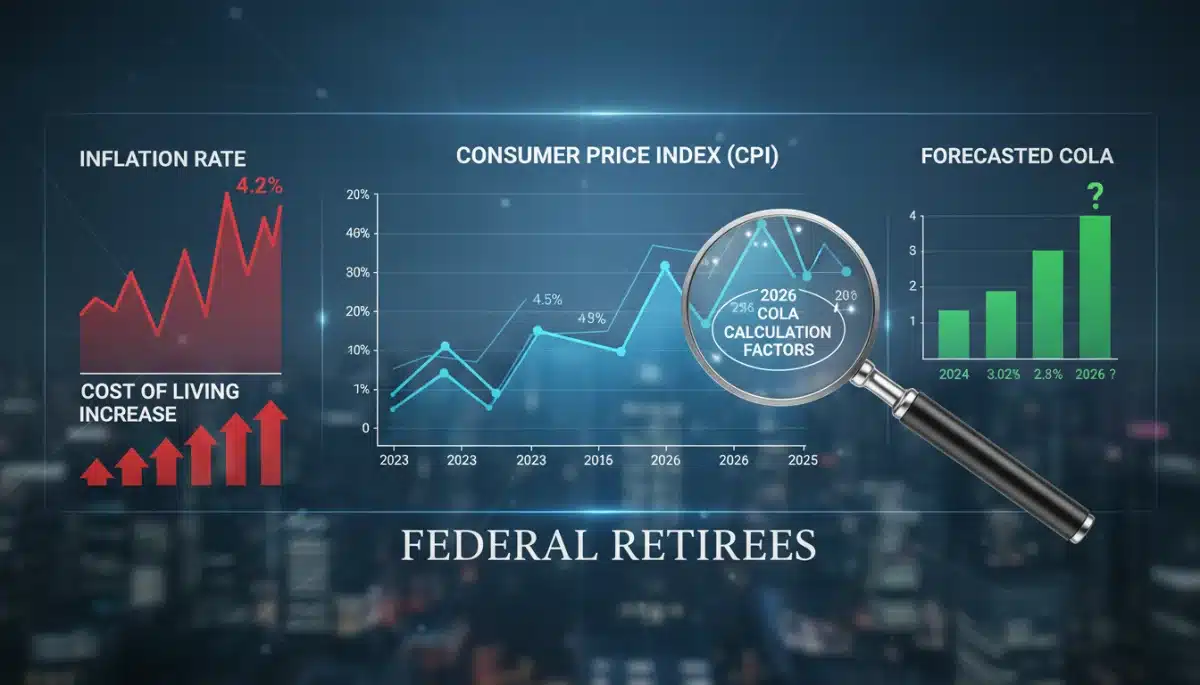
Key Economic Indicators to Monitor
- Consumer Price Index (CPI-W): The direct measure used for COLA calculation.
- Energy Prices: Volatility in oil and gas can significantly impact overall inflation.
- Supply Chain Health: Disruptions can lead to price increases for various goods and services.
The Federal Reserve’s monetary policy decisions, particularly interest rate adjustments, also indirectly influence inflation. Higher interest rates can dampen consumer demand and potentially slow price increases, impacting the future of Federal Employee Retirement Benefits (FERS/CSRS): 2026 Cost-of-Living Adjustments Explained.
Historical COLA Trends and Future Outlook
Examining historical COLA trends provides valuable context for understanding potential future adjustments. Over the past few decades, COLA percentages have fluctuated significantly, reflecting periods of high and low inflation. Recent years have seen higher COLA increases due to elevated inflation.
While past performance is not a guarantee of future results, historical data can help federal retirees contextualize current economic conditions. It also underscores the importance of the COLA mechanism in preserving the long-term value of Federal Employee Retirement Benefits (FERS/CSRS): 2026 Cost-of-Living Adjustments Explained.
The outlook for 2026 suggests a continued focus on managing inflation, which will directly influence the eventual COLA. Experts anticipate a more stable, though potentially still elevated, inflationary environment compared to the peaks of recent years.
Recent COLA History
- 2023 COLA: Significantly high due to post-pandemic inflation surge.
- 2024 COLA: Reflective of easing but still persistent inflationary pressures.
- 2025 COLA: Expected to moderate further, setting a baseline for 2026 projections.
Understanding these historical patterns helps federal retirees and employees better prepare for the financial implications of the Federal Employee Retirement Benefits (FERS/CSRS): 2026 Cost-of-Living Adjustments Explained. It highlights the dynamic nature of retirement planning in an evolving economic landscape.
Impact of COLA on Federal Retiree Finances
The annual COLA directly affects the net income of federal retirees, influencing their ability to cover daily expenses, healthcare costs, and discretionary spending. A robust COLA helps maintain their standard of living, while a lower adjustment can necessitate budget re-evaluations.
For many retirees, their federal annuity, supplemented by Social Security and TSP withdrawals, forms the bedrock of their financial security. Therefore, the magnitude of the Federal Employee Retirement Benefits (FERS/CSRS): 2026 Cost-of-Living Adjustments Explained is a significant concern for their overall financial health.
Retirees often plan their budgets around anticipated COLA increases, making early projections and informed discussions about economic forecasts particularly valuable. This proactive approach allows for adjustments to spending and investment strategies as needed.

Financial Planning Considerations
- Budget Adjustments: Align spending with anticipated COLA for 2026.
- Healthcare Costs: Factor in rising healthcare expenses, which COLA may not fully cover.
- Investment Strategy: Review TSP and other investments in light of inflationary trends.
The cumulative effect of COLA over years significantly impacts a retiree’s long-term financial stability. Even small differences in annual adjustments can lead to substantial variances in total lifetime benefits, making the Federal Employee Retirement Benefits (FERS/CSRS): 2026 Cost-of-Living Adjustments Explained a perennial topic of interest.
Preparing for the Official 2026 COLA Announcement
Federal employees and retirees should monitor official sources for the definitive 2026 COLA announcement, which is typically made by the Office of Personnel Management (OPM) in October of the preceding year. This announcement provides the final, official percentage that will be applied to annuities starting in January 2026.
Until then, staying updated with economic reports, particularly the monthly CPI-W releases from the BLS, can help in estimating the potential adjustment. Reputable financial news outlets and federal employee organizations often provide expert analysis and projections as the data becomes available.
Proactive engagement with these resources ensures that retirees are well-informed and can make timely financial decisions. The period leading up to the official announcement is crucial for understanding the full scope of Federal Employee Retirement Benefits (FERS/CSRS): 2026 Cost-of-Living Adjustments Explained.
Resources for COLA Information
- Bureau of Labor Statistics (BLS): For CPI-W data releases.
- Office of Personnel Management (OPM): For official COLA announcements and policy details.
- Federal Employee Associations: Often provide analysis and advocacy related to benefits.
Leveraging these resources allows federal retirees to remain fully aware of the factors influencing their benefits. Being informed about the Federal Employee Retirement Benefits (FERS/CSRS): 2026 Cost-of-Living Adjustments Explained empowers them to plan effectively for their financial future.
Expert Projections and Analyst Consensus
Financial analysts and retirement benefit specialists regularly publish their projections for the upcoming COLA, offering valuable insights based on current economic models and data. While these are estimates, they often align closely with the eventual official announcement, providing a useful gauge.
Consensus among experts often emerges as the third-quarter CPI-W data becomes clearer, narrowing the range of potential COLA outcomes. These projections help mitigate uncertainty for federal retirees planning their budgets and investments well in advance of the official figures.
It is important to remember that these are projections and not guarantees, but they serve as an excellent tool for preliminary planning regarding Federal Employee Retirement Benefits (FERS/CSRS): 2026 Cost-of-Living Adjustments Explained. They provide an informed perspective on what to expect.
Factors in Expert Projections
- Inflation Models: Utilizing advanced economic models to forecast CPI-W trends.
- Federal Reserve Stance: Analyzing monetary policy and its potential impact on price stability.
- Global Economic Outlook: Considering international factors that can influence domestic inflation.
These expert analyses are crucial for federal retirees seeking to understand the broader economic context impacting their Federal Employee Retirement Benefits (FERS/CSRS): 2026 Cost-of-Living Adjustments Explained. They offer a nuanced view beyond raw data.
| Key Point | Brief Description |
|---|---|
| COLA Calculation | Based on CPI-W from Q3 2025 vs. Q3 2024. |
| FERS vs. CSRS | FERS has tiered caps; CSRS receives full COLA. |
| Economic Influences | Inflation, energy, supply chains directly impact CPI-W. |
| Financial Impact | COLA preserves purchasing power for retirees. |
Frequently Asked Questions About 2026 COLA
The primary factor for determining the 2026 COLA is the Consumer Price Index for Urban Wage Earners and Clerical Workers (CPI-W). Specifically, the average CPI-W for the third quarter of 2025 (July, August, September) compared to the third quarter of 2024 will dictate the percentage increase.
CSRS retirees typically receive the full COLA percentage. FERS retirees, however, have tiered adjustments: full COLA if CPI-W is 2% or less, 2% if CPI-W is between 2% and 3%, and CPI-W minus 1% if CPI-W exceeds 3%. This distinction is critical for Federal Employee Retirement Benefits (FERS/CSRS): 2026 Cost-of-Living Adjustments Explained.
The official 2026 COLA for Federal Employee Retirement Benefits (FERS/CSRS) is typically announced by the Office of Personnel Management (OPM) in October 2025. This announcement follows the compilation and analysis of the third-quarter CPI-W data from the Bureau of Labor Statistics.
Retirees should closely monitor inflation rates, particularly the monthly CPI-W reports, energy prices, and the stability of global supply chains. These indicators significantly influence the cost of living and, consequently, the potential for a substantial 2026 COLA.
COLA is crucial for preserving the purchasing power of federal annuities over time, helping retirees maintain their standard of living. Consistent adjustments ensure that benefits keep pace with inflation, safeguarding long-term financial security and impacting the overall value of Federal Employee Retirement Benefits (FERS/CSRS): 2026 Cost-of-Living Adjustments Explained.
Looking Ahead
The upcoming Federal Employee Retirement Benefits (FERS/CSRS): 2026 Cost-of-Living Adjustments Explained represent a critical juncture for federal retirees. Staying informed on economic forecasts, official CPI-W data releases, and expert analyses will be paramount. These adjustments are not merely numbers; they directly impact the daily lives and financial stability of those who have dedicated their careers to public service. Continued monitoring of these developments will empower retirees to make informed decisions and adapt their financial strategies effectively.